
Another team meeting was held in labs today. We had to resolve how we were going to export our model. We knew how to do it, but unfortunately we needed a version of 3dsmax other than 2009 to use our SDK plug-in.
I emailed Gordon on what the plan for the week was. We had called each other a few times during the week and promised to push our team to finish the model in crysis and have all the necessary files and textures files ready to file front to Gordon by sunday, so that he could place it into our environment.
We arranged another meeting the following sunday so that we could work on exporting, and trying to import everything into crysis.
Friday, May 1, 2009

Project Progress - Exporting From 3dsmax to Crysis
Obstacles in exporting From 3dsmax to Crysis
After finishing our model in 3dsmax, we discovered the complications of importing into Crysis.
Some of the difficulties we ran into were:
 Fig 3.) "Sphere" in 3dsmax
 Fig 4.) "Sphere" in Crysis
 Fig 5.) "Rafters" in 3dsmax
 Fig 6.) "Rafters" in Crysis
After finishing our model in 3dsmax, we discovered the complications of importing into Crysis.
Some of the difficulties we ran into were:
- Uni lab level 3 computers licence for 3dsmax no longer works
- Uni lab level 2 computers runs 3dsmax 2009 which is the only version that wont export into crysis using a SDK plug-in
- Rebecca's laptop for some reason refuses to accept the plug-in even though shes running max 9
- Crysis does not like to import huge collection of objects
- Crysis will not import textures assigned in 3dsmax
- Some imported elements in crysis wll either be scaled down by a 3rd of the size or even mulitplied by 10 times the actual size
- Crysis did not like importing our hedges created in 3dsmax (reason for this is because of its high detail and numerous compents - stems, leaves, textures, etc)
How to export from 3dsmax to Crysis
Step 1.
The first thing you have to do is split up your 3dsmax model into pieces, the reason for this is that crysis doesn't like many groups of objects being exported at once. I believe the number is roughly around 20 elements at once. So we divided the model into 3 main groups. The sphere, the base and the rafters. Then you rename each file and continue to export from there.
 Fig 1.) "Base" in 3dsmax
 Fig 2.) "Base" in Crysis
 Fig 3.) "Sphere" in 3dsmax
 Fig 4.) "Sphere" in Crysis
 Fig 5.) "Rafters" in 3dsmax
 Fig 6.) "Rafters" in Crysis
Step 2.
Make a new folder in the Crysis folders called "Objects"
eg. C:\Program files\Electronic Arts\Crytek\Crysis\Game\Objects
Step 3.
Because we had designed the model using 3dsmax 2009 in labs, for us to export to Crysis we had to first convert our max files into 3ds files, then import them, then save them as 3dsmax scene files, then save them as .cgf files. Below is a more concise process of what we did.
First install the SDK plug-in
Now in 3dsmax:
- Select File > New
- New Scene > Select New All
- File > Import
- 3ds (3D Studio) import > Select 'completely replace...'
- Save in C:\Program files\Electronic Arts\Crytek\Crysis\Game\Objects
- Group all objects
- Name it the same name you just saved it as
- add selected
- Export to Gemetry (*.cgf)
- Export Nodes
Step 4.
In Crysis:
- Create a terrain
- Go to objects in your roll over menu (right hand side)
- Select Brush
- Your new object you just exported should be in the list
- drag it into your terrain
Note: We discovered that everytime you make a new object (.cgf file). You have to close the crysis editor and reload the program for the object to appear in you brush list. (Unfortunately it does not refresh the list inside the program automatically)
From there we continued to export each group of elements and assigned the same coordinate points for all objects so that they would snap back to together in there original positions.
Team Blog
Added to our team blog:
- Project progress (studio discussion with Jeremy and Graham, team discussion)
- Project progress (new design created in 3dsmax)
- Project progress (tectures assigned to model using 3dsmax)
- Week 7 Studio Class
- Team Correspondence
Wiki
Added to our class wiki:
- brief descriptions for communication, records and culture
- Amended my previous additions to this weeks collaboration topics
Week 7 Studio Class
Dr John Barton from City Futures Research Centre UNSW was this weeks guest speaker. I have previously attended one of Jack's lectures before on Urbans development, and found the topics and innovations amazing and quite complex.
He started off explaining what he does for a living and how he's involved in the project UrbanIT Project 2030. Which is a project of collaboration involving many professionals inthe field of design and urban planning to develop and propose what should or could be constructed in the city of sydney in the next few decades.
He's focus was sydney's CBD and its adjacent suburbs. Jack displayed a video he presented in this project of a 3d model of sydney's cityscape and interactive sections of the city that could be built. It was a very cool video and he was also saying that it got some media coverage a few years ago.
The lecture went on to explain the techniques and information available to designers and planners on how digital frameworks support urban development. The players involved in these new systems:
He started off explaining what he does for a living and how he's involved in the project UrbanIT Project 2030. Which is a project of collaboration involving many professionals inthe field of design and urban planning to develop and propose what should or could be constructed in the city of sydney in the next few decades.
He's focus was sydney's CBD and its adjacent suburbs. Jack displayed a video he presented in this project of a 3d model of sydney's cityscape and interactive sections of the city that could be built. It was a very cool video and he was also saying that it got some media coverage a few years ago.
The lecture went on to explain the techniques and information available to designers and planners on how digital frameworks support urban development. The players involved in these new systems:
- local council
- dept. of planning
- developers
- architects
- etc.
All of these actors have to combine every amount of information; plans, data sets, research and ideas to successfully create a structure for urban design.
Their every involvement acts to facilitate the overall goal to create a cohesive and highly functional city. This in turn improves its use as a living environment and pushes for buildings to use other external factors in its design. A concept that will probably be more apparent in the years to come, as all this information may be one day systemised and easy accessible to those who need it.
Tuesday, April 28, 2009
Team Blog
Added to our team blog:
- Week 6 Studio Class
- Project Progress
- Progress Report
- Project Progress - ArchiCAD Design Developments
- Team Meeting
Team Meeting
We managed to gather together in Studio Class for a much needed team meeting. As many us, are unable to get together face to face during the week. A group meeting was a great time for to us to outline some very important project issues. We’re lagging behind schedule because of some significant changes to the design and the environment.
Gordon and I were able to debate and discuss the issue of our design location. The process of using Google earth maps and height maps to model a life like environment in London’s central business district is coming along but after much discussion and research. We’ve decided as a group to relocate the design from Hyde Park to Regents Park. Only a few kilometers away, but a more meaningful and defining landscape in highlighting our design.
Gordon and I were able to debate and discuss the issue of our design location. The process of using Google earth maps and height maps to model a life like environment in London’s central business district is coming along but after much discussion and research. We’ve decided as a group to relocate the design from Hyde Park to Regents Park. Only a few kilometers away, but a more meaningful and defining landscape in highlighting our design.
 Fig 1.) Regents Park map obtained from Google Earth
The surrounding landscape elements in Regents Park suit the Cenotaph more appropriately and certain concepts such as:
- A specified circular, flat plane already exists in the centre of Regents park fro the placement of our building
- This circular space is conveniently large enough to fit our model. We’ve measured an estimated the size using Google earth and our floor plans
- A lake contours around the west side of the building, accentuating a visual landscape at the top platforms of the Cenotaph. A much more defining water feature to our previous site
- The natural plant life around the site/park contrast with the large scale Cenotaph and outer cityscape
- The surrounding perimeter of buildings allows for a more urban look and also permits the viewing of these buildings inside of the Crysis skybox. The Hyde park buildings were so far and expanse that it was unable for viewing at the top of the Cenotaph
- The roads surrounding the park outline the boundaries of our site and accentuate the difference contrast from cityscape to parkland and memorial
All these factors pushed us to progress working on the new site. Gordon and I discussed what sort of changes had to be made and he explained that the process would be an easy transaction as we already know what to do. It’s just a matter of repeating the things we’ve learnt to this new site. We’ve got an existing map of the new park and the site is smaller to work with, hopefully enabling us to further detail and push for greater design.
What need’s to be done now is researching natural environment models, completing the site, modeling the surrounding building and roads, finding tutorials to create lights inside of crisis and implementing our finished model into the environment inside of Crysis.
Week 6 Studio Class
This weeks guest speaker was from UNSW School of Psychology. Tom Denson's talk explored the psychology of teams and how a group dynamic functions differently to that of individual work.
Tom gave us references to previous psychologists works and experiments in social psychology. He compared these social experiments to the everyday workplace and explained that group collaboration has their advantages as well as their disadvantages.
He illustrated how human behaviour is influenced by a majority and those around us. Conformity and public compliance is an overwhelming facet in human behaviour. The mentality to comply when pressured in a group is a very strong yet natural practice.
I found the talk very stimulating and relatable. Everyone has experienced a time when they've had to make a public decision within a group. Whether they have the ability to fight for what they believe is the right solution, or to "go with the flow" and support the group ideal is something everyone deals with diversely.
I thought Tom's presentation was successful in relating to our current group assignments and found the class entralled during his lecture on what they believe was key to social influence in the workplace. Group decision making and the process for efficient team work is fundamental to the outcomes we wish to achieve in this course and Tom Denson gave us a glimpse of what part of that is influenced by human psychology.
Tom gave us references to previous psychologists works and experiments in social psychology. He compared these social experiments to the everyday workplace and explained that group collaboration has their advantages as well as their disadvantages.
He illustrated how human behaviour is influenced by a majority and those around us. Conformity and public compliance is an overwhelming facet in human behaviour. The mentality to comply when pressured in a group is a very strong yet natural practice.
I found the talk very stimulating and relatable. Everyone has experienced a time when they've had to make a public decision within a group. Whether they have the ability to fight for what they believe is the right solution, or to "go with the flow" and support the group ideal is something everyone deals with diversely.
I thought Tom's presentation was successful in relating to our current group assignments and found the class entralled during his lecture on what they believe was key to social influence in the workplace. Group decision making and the process for efficient team work is fundamental to the outcomes we wish to achieve in this course and Tom Denson gave us a glimpse of what part of that is influenced by human psychology.
Wednesday, April 22, 2009
Team Blog
I added to the Team Urbans blog. Revised our team weaknesses and strengths and added a new post "Team Fabrication".
The team fabrication outlines the expected level of resolution that our environment will reach, and detailing individual tasks that need to completed. A strategic plan for the projects progress.
A schedule of designated tasks for each member and the outcomes and goals we hope to achieve.
The team fabrication outlines the expected level of resolution that our environment will reach, and detailing individual tasks that need to completed. A strategic plan for the projects progress.
A schedule of designated tasks for each member and the outcomes and goals we hope to achieve.
Webpaint
- Updated my week 5 sources, 'communication' and 'culture' to webpaint.
- Also edited my last topic additions, 'records' and 'context' on webpaint.
- Added all references to webpaint.
Tuesday, April 21, 2009
Wiki Research
I decided to research and analyse wikipedia's web page on 'Personal computer game'. The topic I have chosen relates to our course as we are using a computer game engine to model our designs.
I had originally typed in wikipedia's search engine toolbar "computer game", but it then automatically redirected me to 'personal computer game.'
I searched again in simplier words; 'computer' and 'gaming' and found that computer games are categorised in various forms. That being, video games - games using a console; arcade games and in our case personal computer game - games using a personal computer.
Through quick category links highlighted in blue and wikipedia's search criteria webpage. Wikipedia illustrated how it wanted users to easily specify what exactly they wanted to search.
I quickly decided to analyse "personal computer game" as we are using PC's instead of consoles in this course.
My first impression of the webpage was the simple layout onto which the information was setup.
There is a permanent column of links, search toolbar and language menus on the left hand side of the page that continues to reside, wherever you navigate through the wikipedia website. Enabling a user to easily direct themselves throughout the website.
The design of the page is very simple, using a white background with black text to detail the written information. No other advertisements and colours are used except in pictures, so to keep the website less confusing and straightforward.
Above the heading 'Personal computer game', there are tabs that users can click that direct them to other features of this webpage.
I had originally typed in wikipedia's search engine toolbar "computer game", but it then automatically redirected me to 'personal computer game.'
I searched again in simplier words; 'computer' and 'gaming' and found that computer games are categorised in various forms. That being, video games - games using a console; arcade games and in our case personal computer game - games using a personal computer.
Through quick category links highlighted in blue and wikipedia's search criteria webpage. Wikipedia illustrated how it wanted users to easily specify what exactly they wanted to search.
I quickly decided to analyse "personal computer game" as we are using PC's instead of consoles in this course.
My first impression of the webpage was the simple layout onto which the information was setup.
There is a permanent column of links, search toolbar and language menus on the left hand side of the page that continues to reside, wherever you navigate through the wikipedia website. Enabling a user to easily direct themselves throughout the website.
The design of the page is very simple, using a white background with black text to detail the written information. No other advertisements and colours are used except in pictures, so to keep the website less confusing and straightforward.
Above the heading 'Personal computer game', there are tabs that users can click that direct them to other features of this webpage.

Fig 1.) Webpage tab sections
- 'article' - the main content of information
- 'discussion board' - where people can add there thoughts on the topic in a forum like message board
- 'edit this page' - a sandbox where users can add and edit information to the main webpage
- 'history' - a statistical list of who edited what on this page and at what time they revised any information or comments
All of these options facilitate users to systematically add to the webpage. Allowing the constant collaborative process to function.
The first section of information below the heading is a quick definition and synopsis of the topic and below it, is table of contents. This table of contents catalogs all the information into a hierachy of data and also acts as a link to jump directly to that specified section of of the page.

Fig 2.) Wikipedia content box
The main body of text is broken up into chronological sections that are defined by easy to read content headings and subheadings. These are formatted with different font settings such as bold and various font sizes. Another example of how wikipedia has made it user friendly is the horizontal line that boxes certain information together and signifies a new section.
At each section of information, across from the heading, a link called '[edit]' directs you to the edit page where one can collaboratively insert there added information or if they wish to modify the existing information.

Fig 2.) Wikipedia edit link and text format
Throughout the whole webpage. Blue hyperlinks are used to direct readers to that specific words own webpage in wikipedia. A very handy tool to allow for that particular word to be researched and understood.
This webpage from Wikipedia successfully illustrates how a collaborative wiki works and how the simple design elements function. The consistency of the website allows for users to efficiently understand how every webpage works and how each reader can contribute to the use of the website.
References
Wikipedia 2009, Wikipedia Foundation Inc., U.S., accessed 20 April 2009, http://en.wikipedia.org/wiki/Personal_computer_game#cite_note-34
Project Progress
Our project the cenotaph is coming along nicely but there are a few details in the design our group are still unsure of. Alot of the interior plans we have available are very unclear and do not showcase very much imformation. Along with some other items such as the top surrounding viewing platfrom and the cut away angles in the main walls.

We have only a few pictures and 3 plan sections of Boullee's work of the Cenotaph and we hope to gather more information from UNSW library or other libraries to enable us to progress in our design.
On thursay 17/04/09 I investigated to see if i could locate more information in books of Boullee's work on the Cenotaph. I managed to borrow 2 books, 1 from UNSW library and 1 from COFA library:
- Etienne-Louis Boullee 1728-1799 Theoretician of Revolutionary Architecture by Jean Marie Perouse de Maontclos
- Boullee by
Unfortunately the book by Perouse de Maontclos was all in French, but luckily my Dad is fluent and so was able to help out. Both books had some additional information and pictures of the Cenotaph but the information wasn't as plentiful as I had hoped. We're still pleased to have gathered some extra information of the Cenotaph as it will all help in understanding the architects original context of the project.
I was able to find 2 great pictures of the Cenotaph that someone had modelled in a program off the internet. The source didnt have any further information of the building but the pictures were great persepective shots, which helped myself and Jo work out some design problems in modelling it up in ArchiCAD.


Project Progress
Further developmemt of the design in ArchiCAD. Using the preliminary design we are now refining certain elements of the building in particular the levels, walls and the entrance.


Team Meeting & Team Blog
We had a team meeting on 12pm Wednesday 15/04/09 at Red centre to discuss tasks and project progression. We met in Lab 2 and outlined what had to be done by each team member during today and this following week. We split up all the work load and worked out how we were going to communicate with Gordon what neccessary files and duties he also had to do.
After a quick meeting we went about using this time together to work on the project in the labs.
Added to team Blog
After a quick meeting we went about using this time together to work on the project in the labs.
Added to team Blog
Wednesday, April 15, 2009
Collaboration Topics - Culture & Communication
CULTURE

"A welsh cultural theorist and a professor at Cambridge University by the name of Raymond Williams famously described culture as 'one of the two or three most complicated words in the english language' (Williams 1979, p.76)" (Milner & Browitt 2002, p.2).
In his book Keywords, Williams discussed the originality of the word culture as the tending or cultivation of something, in particular animals or crops.
"In his first major work, 'Culture & Society', he drew attention to four important kinds of meaning that attach to the word; 'an individual habit of mind; the state of intellectual development of a whole society; the arts; and the whole way of life of a group or people' (Williams 1963, p.16)." (Milner & Browitt 2002, p.2)
"Culture as referring to that entire range of institutions, artefacts and practices that make up our symbolic universe. In one or another of its meanings, the term will thus embrace: art, religion, science and sport, education and leisure. By convention however, it does not embrace the range of activities normally deemed either economic or political" (Milner & Browitt 2002, p.5).
Culture can be through viewed various definitions and is something everyone is affiliated with in all aspects of their lives. It is an essential element in any societies past or present and the true meaning of the word is constantly evolving and overlapping into relation with one another.
Reference
Milner, A & Browitt, J 2002, Contemporary Cultural Theory, 3rd edn, Allen & Unwin, Sydney
COMMUNICATION

"The study of the transfer of meaning" (Eunson 2007, p.4)
"Communication, as applied to human interaction includes:
"Communications (plural) as distinct from communication usually relates to the physics and mechanics of telecommunications systems such as telephone networks, satellites and the internet. A general definition gor these types of communications might be the study of the transfer of data" (Eunson 2007, p.5).
"The difference between singular and the plural usages of communication is to think of the plural encompassing the singular - that is, mechanical transmission enables the transfer of meaning or content" (Eunson 2007, p.5).
"The different types of communication can be represented in such categories:
Eunson, B 2007, Communication in the Workplace, John Wiley & Sons, Sydney

"A welsh cultural theorist and a professor at Cambridge University by the name of Raymond Williams famously described culture as 'one of the two or three most complicated words in the english language' (Williams 1979, p.76)" (Milner & Browitt 2002, p.2).
In his book Keywords, Williams discussed the originality of the word culture as the tending or cultivation of something, in particular animals or crops.
"In his first major work, 'Culture & Society', he drew attention to four important kinds of meaning that attach to the word; 'an individual habit of mind; the state of intellectual development of a whole society; the arts; and the whole way of life of a group or people' (Williams 1963, p.16)." (Milner & Browitt 2002, p.2)
"Culture as referring to that entire range of institutions, artefacts and practices that make up our symbolic universe. In one or another of its meanings, the term will thus embrace: art, religion, science and sport, education and leisure. By convention however, it does not embrace the range of activities normally deemed either economic or political" (Milner & Browitt 2002, p.5).
Culture can be through viewed various definitions and is something everyone is affiliated with in all aspects of their lives. It is an essential element in any societies past or present and the true meaning of the word is constantly evolving and overlapping into relation with one another.
Reference
Milner, A & Browitt, J 2002, Contemporary Cultural Theory, 3rd edn, Allen & Unwin, Sydney
COMMUNICATION

"The study of the transfer of meaning" (Eunson 2007, p.4)
"Communication, as applied to human interaction includes:
- body language or non-verbal communication
- public speaking & presentation skills
- jounalism or writing for the mass media
- graphic coummunication
- writing documents
- website text, design
- public relations
- electronic messages" (Eunson 2007, p.2)
"Communications (plural) as distinct from communication usually relates to the physics and mechanics of telecommunications systems such as telephone networks, satellites and the internet. A general definition gor these types of communications might be the study of the transfer of data" (Eunson 2007, p.5).
"The difference between singular and the plural usages of communication is to think of the plural encompassing the singular - that is, mechanical transmission enables the transfer of meaning or content" (Eunson 2007, p.5).
"The different types of communication can be represented in such categories:
- intrapersonnel - communication that takes place within one person (thoughts, behaviour patterns, perceptions, accurate/distorted thinking, conscious/unconscious thinking, self-talk, affirmations)
- interpersonal - communication that takes place between two people
- group/team - communication that takes place between members of a work group, team or department, involving more than two people
- workplace/organisational - communication that takes place among the group of groups that is an organisation or workplace
- public/media - communication from inside the organisation to the outside world using public communication or public relations methods, and coming back the other way, the attention paid to the organisation by the media
- intercultural - communication that takes place between people from different cultural/ethnic/religious/racial/national groups" (Eunson 2007, p.3-4).
Eunson, B 2007, Communication in the Workplace, John Wiley & Sons, Sydney
Week 5 Studio Class
This weeks guest speaker was from Sosa labs. Neil Brown came and spoke about the way in which people in his field of work collaborate. An interesting and insightful presentation, as alot of his concepts and methods of communicating during a working project are quite similar to which our class and in particular our group is going through and researching.
Neil was saying that he works with the software Linux and is a programmer. He explained that Linux is a software much like windows, but a integral component of how it works is that it is constantly developing and evolving through the process of collaboration. Users inform programmers like Neil about problems and bugs and hence a process of fixing problems begins. Neil is part of a worldwide collaborative effort in running Linux.
Because Neil has to interface with people around the world whilst integrating with customers/users of Linx, most of the tools he uses to collaborate are predominately email, forums and other internet based communication programs. A unique system of collaboration not commonly used in the mainstream workplace. We're more known to collaborate face to face and discuss issues in team meetings rather than with short messages and bulletin boards.
I found the lecture quite motivating as our group has a unique obstacle in collaborating across from Perth to Sydney. We've found it difificult to exchange ideas and information with each other, but after Neils presentation its evident that professional businesses do communicate and manage in such schemes.
Neil was saying that he works with the software Linux and is a programmer. He explained that Linux is a software much like windows, but a integral component of how it works is that it is constantly developing and evolving through the process of collaboration. Users inform programmers like Neil about problems and bugs and hence a process of fixing problems begins. Neil is part of a worldwide collaborative effort in running Linux.
Because Neil has to interface with people around the world whilst integrating with customers/users of Linx, most of the tools he uses to collaborate are predominately email, forums and other internet based communication programs. A unique system of collaboration not commonly used in the mainstream workplace. We're more known to collaborate face to face and discuss issues in team meetings rather than with short messages and bulletin boards.
I found the lecture quite motivating as our group has a unique obstacle in collaborating across from Perth to Sydney. We've found it difificult to exchange ideas and information with each other, but after Neils presentation its evident that professional businesses do communicate and manage in such schemes.
Thursday, April 9, 2009
Strengths & Weaknesses & Team Logo
Posted on our Team Journals 2 strengths, and 2 weaknesses of our Draft Fabrication as well as our class members.
I also designed a team logo in photoshop and uploaded it to our team blog
I also designed a team logo in photoshop and uploaded it to our team blog
Wiki
Allan gave me administrator rights to Webpaint.
I added to the class webpaint wiki. Posting the information gathered on my collaboration topics records and context.
Allan and I worked out a system for our class mates to add their references. We added a new reference page under "Topics of Collaboration" and posted both our references.
I added to the class webpaint wiki. Posting the information gathered on my collaboration topics records and context.
Allan and I worked out a system for our class mates to add their references. We added a new reference page under "Topics of Collaboration" and posted both our references.
Week 4 Presentations
In studio today guest speaker Michael Brand came and lectured on the issues of conflict resolution in the workplace. He ouline the various legal concepts and issues regarding the management of facing conflict in the workplace.
Second half of class was group presentations. Each group presented their first draft fabrication. Their were class discussions after each presentation and we were introduced to every teams concepts and progress learning the CryEngine.
Our team Urbans presented well and with use of images and videos, we were able to illustrate our initial stages of development and present of intentions for future progress.
Jeremy, Graham and Stephen Peter gave us feedback on our first fabrication and explained what was necessary for team urbans to develop in the next stages. We received some positive feedback and hope to heed their advice on certain ideas and strategies.
Second half of class was group presentations. Each group presented their first draft fabrication. Their were class discussions after each presentation and we were introduced to every teams concepts and progress learning the CryEngine.
Our team Urbans presented well and with use of images and videos, we were able to illustrate our initial stages of development and present of intentions for future progress.
Jeremy, Graham and Stephen Peter gave us feedback on our first fabrication and explained what was necessary for team urbans to develop in the next stages. We received some positive feedback and hope to heed their advice on certain ideas and strategies.
Wednesday, April 1, 2009
Assignment 1 Collaboration


ArchiCAD modelling - Developing the building inside the ArchiCAD engine. Particular time and effort was out into created the sphere. Two solid dome were created and mirrored to obtain this large sphere solid.


3dsmax software was used to import into the CryEngine. A SDK plug-in was used to import the solids into crysis.
Virtual Worlds; Second Life, Sony at Home
Second life and Sony at home are virtual 3d gaming worlds where users create avatars in which they can interact with other avatars. One can immerse themselves in a world where they can chat, play games, build spaces, and find communities and express individual ideas globally.
These immersive virtual spaces have penetrated mainstream society and for those who have access to a computer, using these virtual settings are particularly effective in replacing and extending the abilities of modern real-time collaboration systems.
This concept of virtuality in both these two programs, encourage the exploration of ideas through simulated communication. As they relate to a new digital experience, the shared virtual experience puts all users on an equal playing field. Race, sex, age and creeds are left behind for any variety of interactive collaboration to develop.
They are in fact, social systems, where any sort of interaction can occur. These networks allow for virtual relationships and encourage communication through IM chatting and VoIP.
Second Life and Sony at Home interactions can replace real meetings and collaboration to some extent. Besides benefits such as cost and time saving, there is another very important advantage. Being a public space creates opportunity for a wider range of participation and hence ideas. Innovative and additional solutions can result simply because of more participants.
What these programs lack however is its use in collaborating files and transferring of documents, fundamental in business collaboration. But their main advantage is there ability to enable online collaboration in forms of conferences, training and meetings. Collaborating simultaneously, that’s the key concept of such programs as SL and Playstation at Home.
Creating content, consuming content and communicating all at the same time. Mirroring how people like to interact and exchange ideas in the real world.

Fig 1.) Second Life

Fig 2.) Playstation at Home
Additional examples of Virtual Worlds:
These immersive virtual spaces have penetrated mainstream society and for those who have access to a computer, using these virtual settings are particularly effective in replacing and extending the abilities of modern real-time collaboration systems.
This concept of virtuality in both these two programs, encourage the exploration of ideas through simulated communication. As they relate to a new digital experience, the shared virtual experience puts all users on an equal playing field. Race, sex, age and creeds are left behind for any variety of interactive collaboration to develop.
They are in fact, social systems, where any sort of interaction can occur. These networks allow for virtual relationships and encourage communication through IM chatting and VoIP.
Second Life and Sony at Home interactions can replace real meetings and collaboration to some extent. Besides benefits such as cost and time saving, there is another very important advantage. Being a public space creates opportunity for a wider range of participation and hence ideas. Innovative and additional solutions can result simply because of more participants.
What these programs lack however is its use in collaborating files and transferring of documents, fundamental in business collaboration. But their main advantage is there ability to enable online collaboration in forms of conferences, training and meetings. Collaborating simultaneously, that’s the key concept of such programs as SL and Playstation at Home.
Creating content, consuming content and communicating all at the same time. Mirroring how people like to interact and exchange ideas in the real world.

Fig 1.) Second Life

Fig 2.) Playstation at Home
Additional examples of Virtual Worlds:
Assignment 1 Contributions
In the process of developing our Draft Fabrication Environment my contribution has been in:
- Tech testings in exportation into various programs
- Collaborative design inputs in the dimensioning of our building inside ArchCad
- Exporting building from ArchCad to 3dsmax
- Working out how to export into CryEngine using a STK plug-in
- Modifying design in 3dsmax - particularly grouping objects and components and also boolean unwanted objects in 3dsmax
- Updating team blog as well as transferring content into new blog program "Blogger"
- Writing 600 word description of our environment
- Capturing Images highligjhting aspects of Draft Fabrication.
Team Meeting and Correspondence
Working out how we would split up the workload and designating roles for all team members was covered in a team meeting today. We meet up in labs and made a plan on the processess needed to accomplish before thursday. Made sure we discussed through emails and SMS with Gordon over in Perth what our intentions were and how we were going to transfer information, files and ideas to him.
Tuesday, March 31, 2009
Blog Change
After a team discussion. We decided to change our individual and team blogs. Tumblr our previous blogger did not unable us to create a link feature on the side of our blogs and was not very user friendly. My individual blog was also Tumblr and I have also decided to swap blog's in favour of blogger.com. I have transferred all information to my current blog today http://michaelbaoarch1392.blogspot.com/
8 Areas of Inquiry
To realise our project "Cenotaph" in the CryEngine. Our team must rigorously evaluate particular components and to tests if they are viable for future progress of the project.
Such inquiries as:
- Can Crysis materials be punctured or hollowed to allow for the designs main feature holes in the roof be successful in illustrating a daytime skyline.
- Constructing large scale designs in Crysis. The main feature of the building is a 147m diameter sphere.
- Can we export from ArchiCAD to CryEngine.
- Can we export from Microstation to CryEngine
- Can we export from 3dsMax to CryEngine
- Can we export from SketchUp to CryEngine
- Can we export from Revit to CryEngine
- Is it possible for lights to penetrate through materials to give that effect of stars in the roof?
Presenting Individual Unbuilt Architectures
In our week 2 studio class we gathered in our teams and discussed and presented our individual ideas on unbuilt architecture. The meeting consisted of each member presenting their own research and why they thought it would be favourable to use in the project. Our discussions outlined the advantages and disadvantages of particular projects and if they were feasible in crysis and if they has potential for a great project.
After each case was summed up, we has settled on 2 projects. Étienne-Louis Boullée's memorial to Issac Newton the "Cenotaph" and Vladimir Tatlin's Tatlin's Tower.
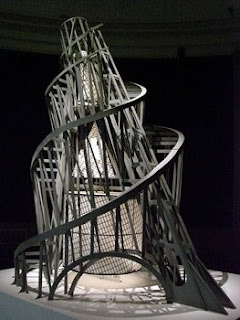
Fig1.) Tatlin's Tower
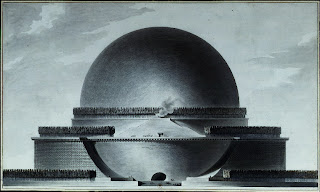
Fig 2.) Memorial to Issac Newton the "Cenotaph"
After a consultation with tutors Jeremy and Graham, they gave us encouragement to pursue developing the memorial to Issac Newton. We discussed with them the possibilities of building such a large structure in crysis and the elements of shadow, lighting and enclosure. The benefits and key concepts of the Cenotaph were strong and the opportunity to build such an interesting design would incaptulate the investigation into virtual construction. We finally decided it was the right choice and that with Crysis we could take advantage its high power modelling capabilities, to construct an impressive structure as well as an environment.
After each case was summed up, we has settled on 2 projects. Étienne-Louis Boullée's memorial to Issac Newton the "Cenotaph" and Vladimir Tatlin's Tatlin's Tower.

Fig1.) Tatlin's Tower

Fig 2.) Memorial to Issac Newton the "Cenotaph"
After a consultation with tutors Jeremy and Graham, they gave us encouragement to pursue developing the memorial to Issac Newton. We discussed with them the possibilities of building such a large structure in crysis and the elements of shadow, lighting and enclosure. The benefits and key concepts of the Cenotaph were strong and the opportunity to build such an interesting design would incaptulate the investigation into virtual construction. We finally decided it was the right choice and that with Crysis we could take advantage its high power modelling capabilities, to construct an impressive structure as well as an environment.
Collaboration Topics - Records & Context
RECORDS


To preserve the memory of, by committing to writing, to printing, to inscription, or the like; to make note of; to write or enter in a book or on parchment, for the purpose of preserving authentic evidence of; to register; to enroll; as, to record the proceedings of a court; to record historical events.
"The definition of record in the Australian Standard AS 4390-1996 reads:
'...recorded information, in any form, including data in computer systems, created or received and maintained by an organisation or person in the transaction of business or the conduct of affairs and kept as evidence of such activity' (Standards Australia 1996 pt.1 p.7, 4.21)" (Kennedy & Schauder 1998, p.5).
"Records may be in any form for example:
- paper, microfilm or electronic
- documents or files, maps, plans, drawings, photographs etc.
- data from business systems, word processed documents, spreadsheets, electronic mail messages, digital images
- audio or video
- handwritten documents
- loosely structured records such as correspondence or highly structured records such as forms" (Kennedy & Schauder 1998, p.5,6).
"Records can be categorised in a number of different ways. Commonly recognised categories include:
- Administrative records - procedures documentation, forms and correspondence. Eg. staff manuals, rosters, logging of property maintenance jobs etc.
- Accounting records - reports, forms and related customer billing records
- Project records - correspondence, notes, project development documentation
- Case files - client records, personnel records, insurance, contacts etc" (Kennedy & Schauder 1998, p.6).
Reference
Kennedy, J & Schauder, C 1998, Records Management, Addison Wesley Longman Australia Pty Ltd, South Melbourne.
CONTEXT
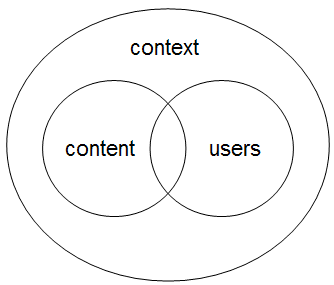


"Context is any information that can be used to characterize the situation of an entity. An entity is a person, place, or object that is considered relevant to the interaction between a user and an application, including the user and applications themselves" (Dey 2001 p.3).
"Context is the environment or situation" (Dey 2001 p.3).
"Adam Schilit claims that the important aspects of context are: where you are, who you are with, and what resources are nearby" (Dey 2001 p.3).
"J. Pascoe defines context to be the subset of physical and conceptual states of interest to a particular entity" (Dey 2001 p.3).
"Context is all about the whole situation relevant to an application and its set of users. We cannot enumerate which aspects of all situations are important, as this will change from situation to situation" (Dey 2001 p.3).
"If a piece of information can be used to characterize the situation of a participant in an interaction, then that information is context" (Dey 2001 p.4).
Reference
Dey, A.K 2001, 'Understand and Using Context', Personal and Ubiquitous Computing, vol. 5, no. 1, February, pp.4-7.
Week 1
Introduction
12th March - Digital Collaboratoin Studio class number one, consisted of allocating teams and introducing the assignment.
Our first meeting as group meant we had to decide on a collaborative team name.
We came up with team URBANS!
The team members are:


12th March - Digital Collaboratoin Studio class number one, consisted of allocating teams and introducing the assignment.
Our first meeting as group meant we had to decide on a collaborative team name.
We came up with team URBANS!
The team members are:
- Myself
- Gordan Davies
- Joanne Vella
- Rebecca Pui Pui Yeung
During our meeting we've found that one of our members resides in Perth. Gordan is orignally from Perth and moved to Sydney to complete Architectural Computing at UNSW. He currently works for a mining company in Perth and now resides there also. He travels to uni every Thursday for Arch1392 Studio and then flys back home the very same night. The difficulty in face to face group meetings will be an obstacle for all of us, but we will strive to manage our collaborative skills and communicate our processes electronically over the internet.
In Depth Basic Tutorial
Worked through all the Crysis tutorials from the Incrysis website.
http://incrysis.com/forums/viewtopic.php?id=11847&p=1

In Depth Basic Tutorial
Worked through all the Crysis tutorials from the Incrysis website.
http://incrysis.com/forums/viewtopic.php?id=11847&p=1

Fig 1.) M1

Fig 2.) Helicopter

Fig 3.) In game

Fig 4.) Flow Graph


Fig 5.) Solids


Fig 6.) Flatten Terrain

Fig 7.) M2


Fig 8.) Adding AI

Fig 9.) Roads

Fig 10.) Prefab

Fig 11.) Placing guardhouse on a terrain


Fig 12.) Voxels Cave

Fig 13.) Time of Day

Fig 14.) Voxels
Unbuilt Architecture Research
1.) The 7th Proposal by John Joseph
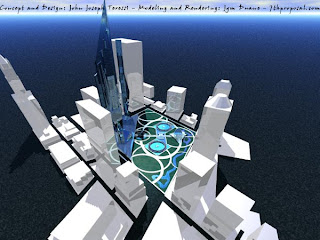
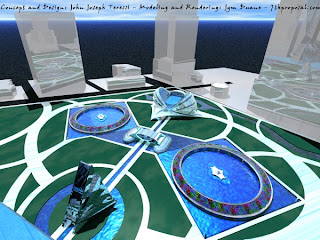
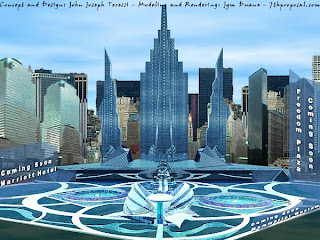
The 7th Proposal, an innovative, unsolicited design for the World Trade Center Complex, is being offered as an alternative to the proposals recently submitted in New York City. John Joseph Teressi, a visionary architectural designer residing in Los Angeles, believes the entire World Trade Center site should be a memorial and “an affirmation of the human spirit’s ability to rise, through tragedy, to a higher level. At the same time, of course, the site must be economically feasible and provide for office space and residential and commercial activities.”
The 7th Proposal’s World Trade Center site consists of: Victory Plaza with three towers on a 7-story commercial and residential triangular base; Freedom Plaza, an office, commercial and hotel complex; Rally Center -Children’s Exposition and Creativity Center; the Memorial Museum and Chapel of Wings, plus a design for the Marriott Hotel. The footprints of the Twin Towers are lakes, connected by a Memorial Bridge, which contains an atrium and botanical gardens. Hovering ten feet above the lakes are stained-glass rings that send rainbows of light over the cascading water. Parkland includes a great variety of flowers and trees with an amphitheatre, and a Maze of Memories with a large globe fountain, surrounded by a bronze Ring of Names.
The 7th Proposal was conceived when Teressi read about the public rejection of the six original proposals. He began to envision a site which would simultaneously honor those lost and provide an inspiration for future generations. “Buildings sculpt space in very specific ways, and people resonate to that fact much more than we realize.
2.) Underwater Archaeological Museum by Jacques Rougerie

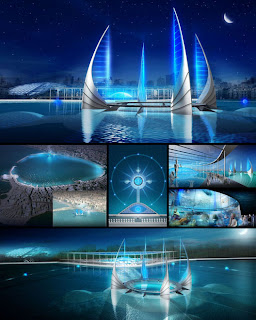
French architect Jacques Rougerie's underwater archealogical museum of alexandria in Egypt.
The concepts of underwater and surface inside water can be accentuated beautifully using crysis. The modelling engine allows for visually appealing realistic water. Something unusual and unseen in reality and our modern day architecture.
1.) The 7th Proposal by John Joseph


The 7th Proposal, an innovative, unsolicited design for the World Trade Center Complex, is being offered as an alternative to the proposals recently submitted in New York City. John Joseph Teressi, a visionary architectural designer residing in Los Angeles, believes the entire World Trade Center site should be a memorial and “an affirmation of the human spirit’s ability to rise, through tragedy, to a higher level. At the same time, of course, the site must be economically feasible and provide for office space and residential and commercial activities.”
The 7th Proposal’s World Trade Center site consists of: Victory Plaza with three towers on a 7-story commercial and residential triangular base; Freedom Plaza, an office, commercial and hotel complex; Rally Center -Children’s Exposition and Creativity Center; the Memorial Museum and Chapel of Wings, plus a design for the Marriott Hotel. The footprints of the Twin Towers are lakes, connected by a Memorial Bridge, which contains an atrium and botanical gardens. Hovering ten feet above the lakes are stained-glass rings that send rainbows of light over the cascading water. Parkland includes a great variety of flowers and trees with an amphitheatre, and a Maze of Memories with a large globe fountain, surrounded by a bronze Ring of Names.
The 7th Proposal was conceived when Teressi read about the public rejection of the six original proposals. He began to envision a site which would simultaneously honor those lost and provide an inspiration for future generations. “Buildings sculpt space in very specific ways, and people resonate to that fact much more than we realize.
2.) Underwater Archaeological Museum by Jacques Rougerie


French architect Jacques Rougerie's underwater archealogical museum of alexandria in Egypt.
The concepts of underwater and surface inside water can be accentuated beautifully using crysis. The modelling engine allows for visually appealing realistic water. Something unusual and unseen in reality and our modern day architecture.
Subscribe to:
Posts (Atom)